Less ctrl+F, more legal assessment
How SIGNUM legal managed due diligence on 100+ contracts

Praktik
Tím Praktik.aiA due diligence project that would traditionally take a month, two lawyers completed faster, saving most of the time with Praktik.ai and being able to focus on what is truly important: legal assessment, document control, and high efficiency for the client.
Due diligence on a hundred documents
The client came with a request for due diligence. There were over a hundred contracts on the table that needed to be checked against a unified set of criteria, identify risks, verify completeness according to law and the client’s internal regulations, and map substantive and risk clauses across the entire portfolio of contracts.
You know this. The same questions, the same criteria, just a different document. And you know that for the next few weeks you will spend opening files, ctrl+F, searching for relevant clauses, and manually transcribing findings into a spreadsheet.
It was really a lot of documents that needed to be processed in the same way.

With a traditional approach, two lawyers would work on the project for about a month. Most of this time would go into mechanical work: opening documents, searching, copying into an Excel spreadsheet.
SIGNUM legal decided to do it differently.
How the project proceeded
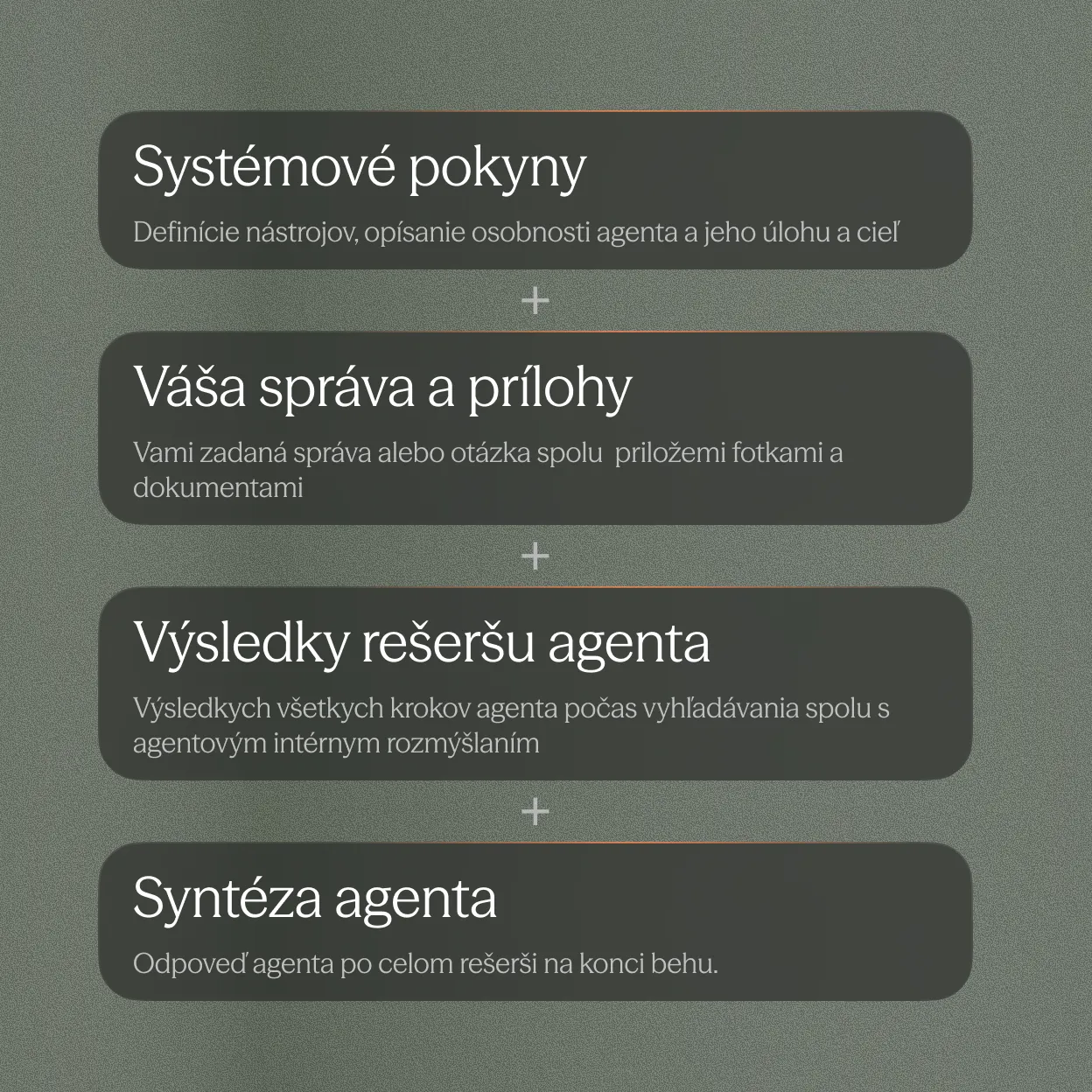
The work was divided into three phases. In the first, the criteria were prepared; in the second, the system processed the documents; and in the third, the lawyers verified the outputs. The burden of human labor shifted from searching to thinking. Instead of spending weeks opening files and copying clauses into a spreadsheet, they could invest time where it really matters: in preparing the checklist and assessing the results.
Phase 1: Preparation
They started with uploading. The entire portfolio, over a hundred contracts, went into the system at once. No rationing, no dividing by chapters.
The question of security immediately arose. Due diligence involves sensitive client documents, and these cannot end up on servers outside the EU or be used for training external models. Praktik.ai is built for the legal environment: data remains within the European Union, encrypted during transfer and storage, in compliance with GDPR. You can find more about how Praktik.ai approaches security here.
Then came the part that determined the quality of the entire project: defining the criteria. During manual due diligence, this is usually done quickly, because every extra hour on the checklist is an hour missing when processing documents. This is where SIGNUM could turn it around. Since the system handles the extraction, the lawyers could afford to spend as much time preparing as they deserved: researching relevant legislation, reviewing case law, thinking through edge cases, and compiling a checklist that truly covered what mattered.
Praktik also helped them with this research. Searching in Slovak and Czech legislation and case law allowed them to quickly process a large volume of material, find specific provisions and decisions relevant to the client’s situation, and tackle edge cases that would easily be missed during manual review. Once the checklist was ready and verified, they could move on to the next phase: the extraction itself, now with a clearly defined set of questions that needed to be answered in every document.
Phase 2: Automated Extraction
Once the checklist was ready, came the part that represents the most tedious weeks of the project in a traditional approach. This required minutes of setup.
Definition of what needs to be found. For every question, the team chose what form of answer the system expected. Sometimes a yes/no is enough; other times a specific sum, effective date, or literal citation of a provision is necessary. This step forces the checklist to maintain a clean format and makes the outputs comparable: if the column “amount of contractual penalty” has the same type everywhere, it can be filtered, sorted, and summed. This is impossible with free text.
The extraction itself. After launching, the system processed all over a hundred documents and filled out the corresponding row in the table for each one. The lawyers did not have to sit and wait; it ran in the background while they did other work.
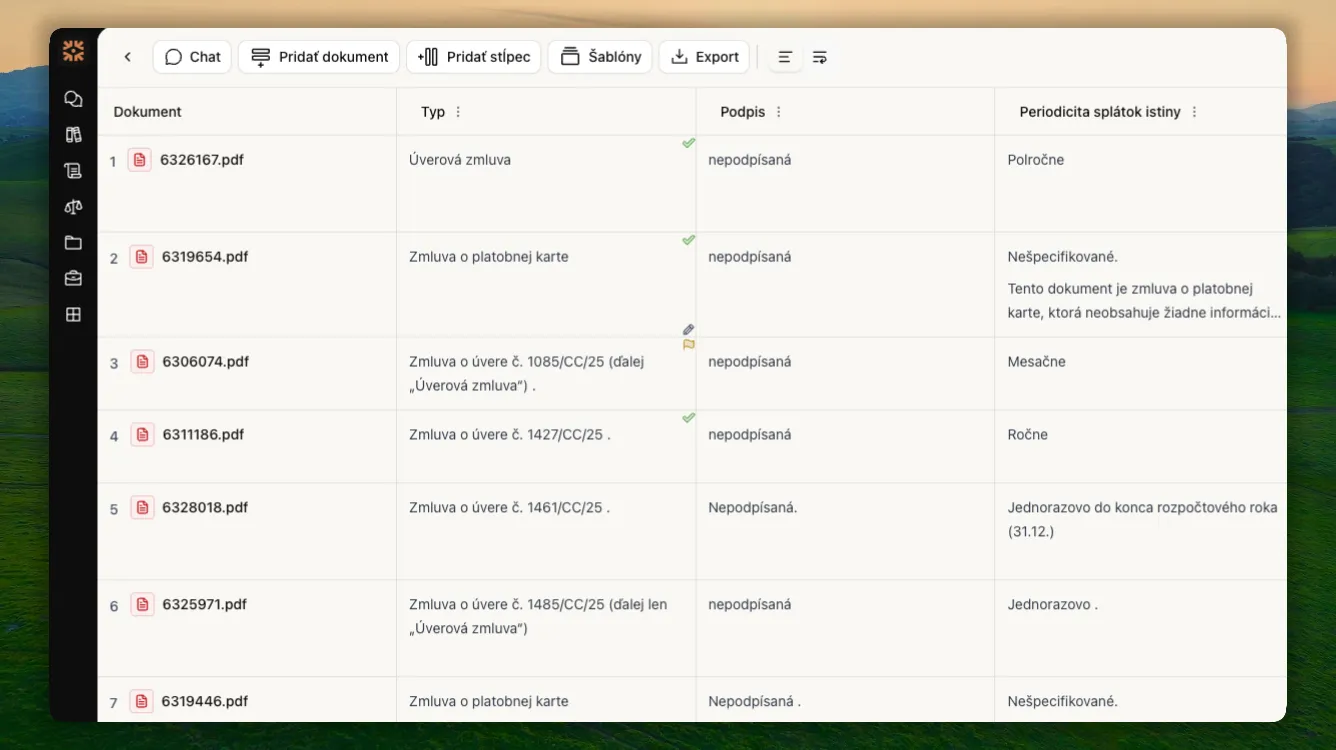
Output as one matrix. What resulted was not a stack of separate notes for individual contracts, but one clear table. Rows are documents, columns are questions. At a glance, it was visible how the entire set of contracts stands regarding every criterion: which contain a given clause, which do not, where there are deviations from the standard, where the same numbers repeat. With manual work, such a view is practically impossible to achieve, because by the time you read contract number eighty, you no longer remember the first one.
The project remains open. When the client sends another twenty contracts a week later, there is no need to start over. The documents are added to the same space, and the system only completes new rows. If it turns out that a new question needs to be added, a column is added and calculated. The rest of the table remains untouched. Due diligence thus ceases to be a one-time output and becomes a living workspace that evolves with the case.
Phase 3: Verification
The project does not end with extraction. A table full of answers is working material, not a client output. The lawyer must stand behind every row, which means that every answer must be checked. The question is therefore never whether to check, but how quickly the check can be accessed.
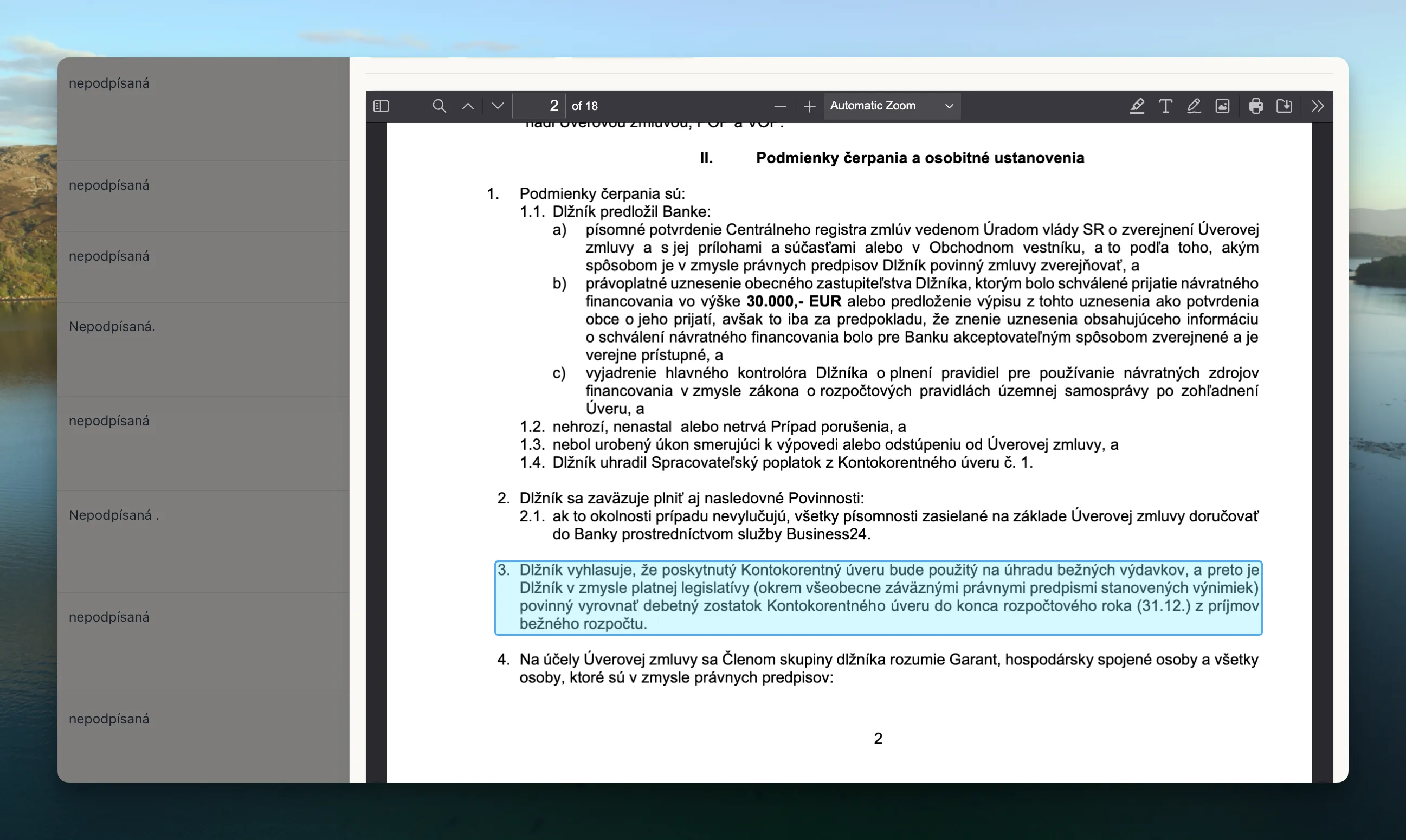
This is where the link between the answer and the source is the most important function of the entire table. Every cell holds a link to a specific place in the original. By clicking, the document opens and the system highlights the exact section of text from which the answer originates. Verification thus changes from the discipline of “find it in the contract” to the discipline of “assess whether this place answers this question.” The first is work for minutes, the second for seconds, and in this difference lies most of the time saving.
I like that you have AI already incorporated into the environment. You have your own database of documents and you can work with it rationally. And the double-checks work: you see the reference source, it throws out the law. You don't make it up like ChatGPT.

The second thing that the verification phase solves is teamwork. Two lawyers were on the project, and the system allows every checked cell to be marked with the name of the person who checked it. In practice, this means three things. The work can be divided without the risk that both people process the same contract. It is always clear what is done and what is still pending. And when submitting the output to the client, there is an audit trail showing who checked what.
When these three phases combine, the nature of the work does not change in that people do something completely different. It changes in how much time it takes during the day. The mechanical part, which once took weeks, is now reduced to hours. The assessment part, which brought the most value, gets the space it deserves, and the client, who standardly expects quality, also gets significant efficiency. Simply satisfaction on both sides.
Results
The project, which would take two lawyers over a month in the old model, was finished much sooner. More interesting than the numbers themselves is where that saved time was redirected.
It is not that they suddenly did less work. They did different work. Hours that they would otherwise spend opening documents and transcribing clauses into a table, they could invest in preparing the checklist and assessing the results. These are, by coincidence, exactly the two areas where the quality of the entire due diligence rests. The mechanical part is what the client doesn’t see. Preparation and assessment are what they pay for.
There is a significant saving of administrative time, of back-office work, document organization, and searching. And that saved time can be dedicated to what really matters.
The second thing to feel with this scope is consistency. A person going through a hundred contracts in order does not read them as carefully as the first. It is fatigue, not negligence, and in manual due diligence, this is accounted for as an invisible tax. The system does not pay such a tax. It applies the same criteria to the first and the last document equally, which means that the output is not only faster but also internally more consistent than it would be after a month of manual work.
And then there is the third, most important thing, which must be named precisely so that no one is confused about what this entire project is actually about.
Beyond the boundary of legal assessment, it is a tool that serves us to process the basis so that we have a more effective basis for legal assessment. The legal assessment itself, that is the domain reserved for the lawyer, judge, or legal professional. That is the boundary.

This quote is worth reading twice, because it defines the dividing line that case studies on AI in law often blur. Praktik does not assess contracts. It prepares the basis for assessment. The difference is fundamental, and it explains why it makes sense to give the system a hundred documents and at the same time why the output still requires a lawyer. That boundary is not an obstacle that should gradually move. It is the definition of responsibility.
When we look at the entire project from this angle, the economics of due diligence do not change because a machine replaces a human. It changes because the work surrounding legal work is finally condensed to a size that makes sense, and the lawyer retains in their hands exactly what the client pays for their hour.
Who is it suitable for
This approach makes sense everywhere you are solving the same questions across a multitude of documents:
Due diligence. Whether it is an M&A transaction, property purchase, or investor entry, you need to process a lot of documents and systematically map risks.
Contract portfolio review. The client wants to know everything contained in the supplier contracts. Or you need to check if all contracts meet new internal standards.
Compliance audits. GDPR, ISO, internal guidelines, checking if documents contain the necessary details.
Bulk verification of details. Checking the details of submissions, complaints, contracts before signing.
Try it out
If you are solving a similar project, or just want to see what it would look like with your documents, we would be happy to show you how.
Schedule a demo | Try for free
Case study created in cooperation with SIGNUM legal. April 2026