
Additional sources are curated official materials beyond legislation, case law, and official registers. They include publications from regulators, public authorities, and EU bodies that can help explain how rules are interpreted or applied in practice.
What additional sources are
Praktik keeps these materials separate from the core legal sources so you can decide when to include them. They are still selected from trusted official institutions and linked to the original publication.
Examples (not a complete list): guidance and recommendations, authority decisions, methodological instructions, periodicals, and other official publications.
Complete list of configured sources
The list below is generated from the same shared registry as the complete list of official sources. It shows every currently configured additional regulator or authority integration for Slovakia, Czechia, and the European Union.
13 configured source integrations
This is a count of configured additional source integrations, not documents or decisions; distinct integrations may belong to the same institution.
Each short description summarizes the categories Praktik processes from that public official source.
Additional regulator and authority sources (13)
Selected official materials from regulators, authorities, and EU bodies.
Slovakia
- Geodézia SR skgeodesy.skDepartmental geodesy and cadastre periodicals and PDF files.
- Departmental geodesy and cadastre periodicals and PDF files.
- Finančná správa SR financnasprava.skTax and customs guidance, official pages, and linked documents.
- Public Procurement Office (ÚVO) uvo.gov.skProcurement decisions, guidance, HTML records, and PDF files.
- Regulatory Office for Network Industries (ÚRSO) urso.gov.skRegulatory decisions and related HTML and PDF documents.
- Antimonopoly Office of the Slovak Republic antimon.gov.skCompetition guidance and official documents.
- Telecom, spectrum, postal, and supervisory decisions and publications.
- Environment ministry bulletin issues and PDF files.
- Regulatory decisions, bulletins, opinions, consumer guidance, and PDF files.
Czechia
- Office for Personal Data Protection (ÚOOÚ) uoou.gov.czDecisions, completed inspections, methodologies, and recommendations.
- Office for the Protection of Competition (ÚOHS) uohs.gov.czProcurement decisions, methodologies, publications, and related court-review documents.
- Czech National Bank (CNB) cnb.czSupervisory decisions, financial-market opinions, bulletins, and warnings.
European Union
- European Data Protection Board (EDPB) edpb.europa.euGuidelines, Article 64 opinions, Article 65 binding decisions, and downloads.
How we collect and update them
We collect additional sources from official public websites and databases where automated access is supported. Each material is cleaned, structured, indexed, and linked with metadata such as its title, institution, publication date, and original source URL where available.
Updates follow the publication cadence of each institution. Praktik checks for newly published material and adds it after processing; these sources do not necessarily follow the daily refresh cycle used for legislation and newly published decisions.
How to select additional sources
Additional sources are available from the jurisdiction/source selector. Open the selector, expand Additional sources, choose a jurisdiction or institution, and enable the sources you want to include in your chat or research.
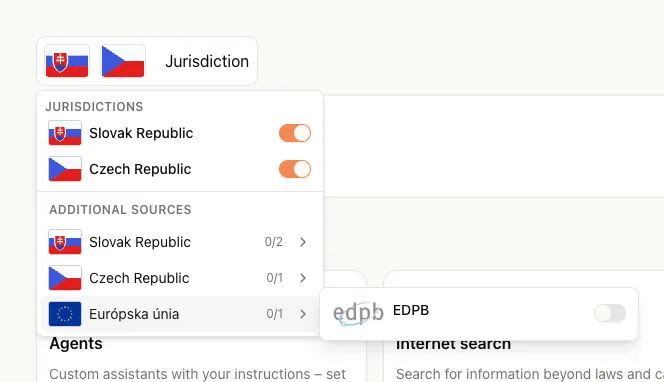
You can mix them with core sources and across jurisdictions. For example, combine Slovak legislation and case law with a Czech regulator source or selected EU authority materials when that context is useful.
Internet search is separate from these official integrations. It must be explicitly enabled, is not counted in the inventory, and is not presented as an official source here.
When to use them
Use additional sources when you need practical interpretation, administrative guidance, authority practice, or specialized materials beyond the text of legislation and court decisions. They are useful for checking how a regulator explains a rule or how an authority applies it in recurring situations.